TRY IT
Type an English name
First and last names work. Trace the whole spelling here, right to left. Not a legal name change.
דוד
Usual Hebrew spelling. Trace the whole name on the pad.
Trace the outline
Finger, stylus, or mouse
The first Hebrew most people want to write is not “peace.” It is their name, on a notebook or a gift. Fair. Also a trap: if you copy D-A-V-I-D with Hebrew-looking doodles, you have not written David. You have written an English word in a costume.
The box at the top of this page — or the standalone tool at /name — uses a small list of common names, then a sound-to-letter guess. Treat the guess as a tracing list, not a passport.
Use Hebrew letters, from the right
David in Hebrew is דוד — dalet, vav, dalet. Three shapes. Start on the right.
Sarah is שרה. Rachel is רחל. Those are usual spellings, not a decoder ring for every English nickname.
How to practise the letters in it
Do not write the whole name fifty times while the shapes are still mush. Take the first letter. Trace it. Then the next. A name is a short unit: three to six traces, not a poster.
When a letter sits at the end of the name, it may need a final form (ך ם ן ף ץ). The tool will pick those when it can. Why finals exist.
After the name
If the name was the hook, the alphabet is still the path. How to write Hebrew letters, or get a starting unit — people who already read can skip the alphabet unit and start with words.
Frequently Asked Questions
Quick answers to common questions.
No. Common biblical names have usual spellings (David is דוד). Made-up phonetic guesses are for practice, not documents or tattoos you cannot undo.
Related Articles
View All →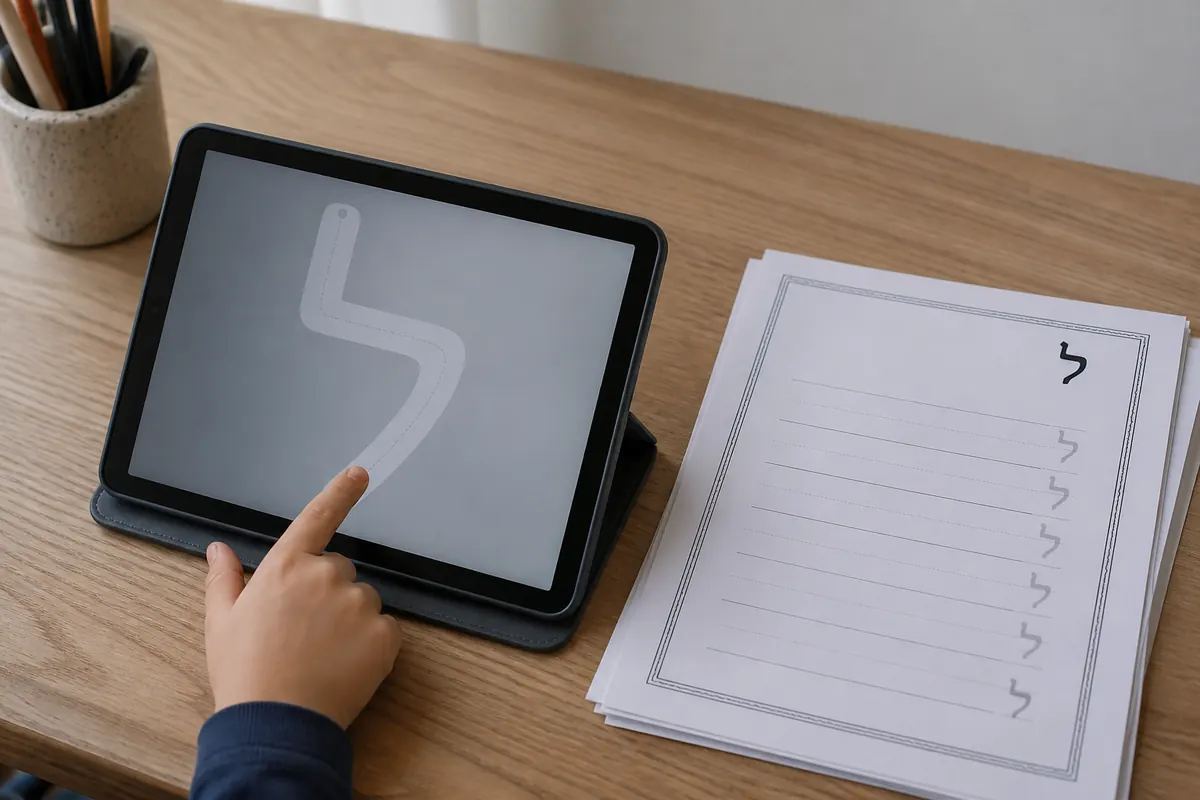
How to write Hebrew letters (the way a hand actually learns them)
Hebrew alphabet for beginners